- Home
- Living in Los Gatos
- Town Departments and Services
- Parks and Public Works
- Capital Improvement Program
- Pavement Management Program
Pavement Management Program
Street Repair and Resurfacing
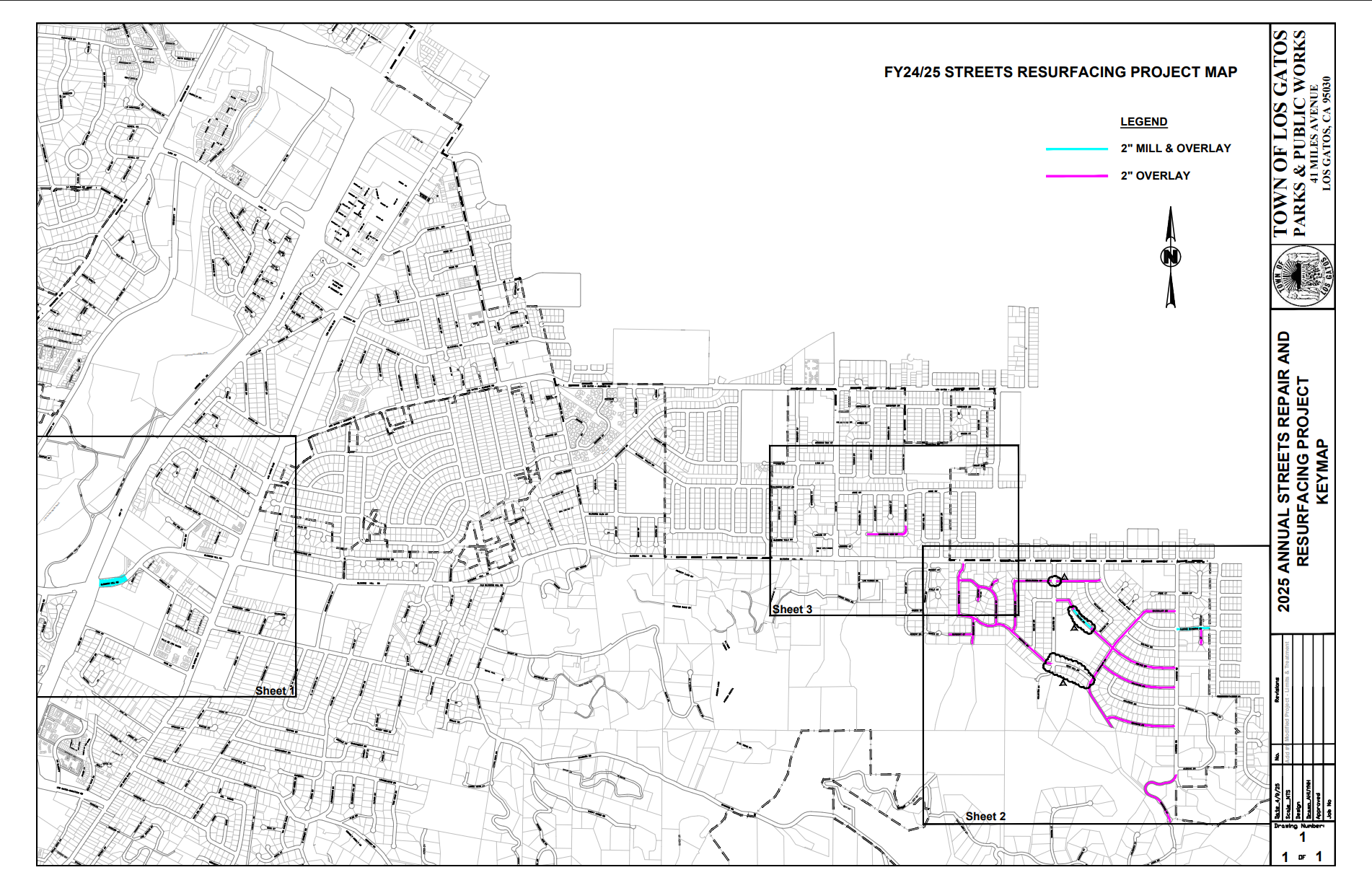
The Town of Los Gatos has about 113 centerline miles of streets. The Parks and Public Works Department administer a comprehensive program to repair and maintain local streets. To look further, these are our 2025 Annual Street Resurfacing Locations.
How is this repair program funded?
The town utilizes a mix of various funding sources to finance street maintenance. Some sources of funding include gas taxes, such as the Road Repair and Accountability Act (SB 1) of 2017. Other sources are found in Local 2010 funds from Valley Transportation Agency (VTA), Measure B funds from Santa Clara County, and Construction and Refuse Vehicle Road Impact Fees.
How does the Parks and Public Works Department choose?
Streets are prioritized based on the Pavement Condition Index (PCI), field inspections, traffic level, and safety issues. The PCI is a numeric value reflecting the condition of a street's asphalt pavement. PCI values can range from a high of 100 for new streets to a low of 0 for streets that need reconstruction. The Town stores the PCI values in a Pavement Management System (PMS) which categorize current and future conditions and generates budget projections for the street repair program.
Additionally, the PCI, in conjunction with existing pavement distresses, ride quality, and structural integrity, are used to determine the appropriate maintenance treatment for our streets. Roads with higher PCI are assigned preventative treatments to preserve their quality. Whereas roads with lower PCI scores require more extensive rehabilitation treatments. Through this, each road receives the most suitable and cost-effective maintenance, optimizing available funding and extending the life of our roads.
This methodology and system are further discussed in the Town of Los Gatos Pavement Management Options Report.
What types of treatments does the Parks and Public Works Department do?
The street repair and resurfacing program consists of two types of treatments: preventative and rehabilitation.
Preventative Treatments
Preventative treatments consist of various tools and methods like crack sealing, localized pavement repairs, slurry seal, microsurfacing, and rubber cape seals. These treatments intend to extend the life of the pavement and slow down road deterioration.
What are some examples of Preventative Treatments?
- Slurry Seal
A slurry seal is a cost-effective pavement treatment designed to extend the life of the roads and improve their appearance. It involves applying a mixture of asphalt emulsion, fine crushed rock, water, and additives to the existing pavement surface. This process seals small cracks, prevents water damage, and provides a fresh, smooth surface with improved traction. Ideal for residential streets and parking lots, slurry seal maintenance ensures safer and more attractive roadways for our community.
- Rubber Cape Seal
A rubber cape seal is an effective pavement preservation technique that combines a chip seal and a slurry seal, enhanced with rubberized asphalt for added durability. This treatment involves applying a layer of rubberized asphalt, followed by a layer of crushed stone (chip seal), and then a slurry seal on top. This multi-layer approach provides a robust, flexible surface that seals cracks, prevents water damage, and improves road longevity.
After a chip seal is applied, it is normal to see loose rock chips on the road. This is a standard part of the process. The chip seal needs a week to cure, during which loose chips will settle. Following this, a slurry seal will be applied on top. Once the slurry seal has cured, the loose rock chips will be embedded in the surface, with no loose chips on the street.
Cape seal is ideal for heavily trafficked roads, rubber cape seals offer enhanced skid resistance and a smoother, more resilient roadway, ensuring safer and longer-lasting streets for our community.
Rehabilitation Treatments
Rehabilitation treatments consist of various tools and methods like asphalt overlays (commonly referred to as resurfacing) and Full-Depth Reclamation (FDR). These types of treatments are known to be more extensive and expensive. However, they significantly improve public safety by eliminating road hazards.
What are some examples of Rehabilitation Treatments?
- Asphalt Overlay
This treatment involves applying a new layer of asphalt over the existing pavement surface, typically 1.5 to 3.0 inches thick. The overlay is designed to smooth out imperfections, restores structural integrity, and enhances ride quality. Essentially, it seals small cracks, prevents water infiltration, and provides a fresh, durable surface that can withstand heavy traffic. As a result, it improves safety, reduces long-term maintenance costs, and enhances the overall appearance of our streets.
Further Questions
If you have any questions, please refer to the list of Frequently Asked Questions (FAQ). Alternatively, you can contact the Parks and Public Works Department at PPW@LosGatosCA.gov or speak directly with Engineering at (408) 399-5771.